Platform Architecture
The Cohort Discovery Service operates across multiple organisational boundaries using a federated model. Each Data Custodian maintains full control of their data within their own infrastructure.
High-level architecture
%%{init: {'flowchart': {'nodeSpacing': 40, 'rankSpacing': 70, 'padding': 20}}}%%
flowchart TD
    Browser[Researcher Browser]

    subgraph HDRUK["HDR UK"]
        GW[Health Data Research Gateway]
        CDS[Cohort Discovery Service API]
    end

    subgraph CustodianX["Custodian X Infrastructure"]
        BUNNY_XA[BUNNY A]
        BUNNY_XB[BUNNY B]
        OMOP_X[(OMOP Database X)]
    end

    subgraph CustodianY["Custodian Y Infrastructure"]
        BUNNY_Y1A[BUNNY A]
        BUNNY_Y1B[BUNNY B]
        OMOP_Y1[(OMOP Database Y1)]
        BUNNY_Y2A[BUNNY A]
        BUNNY_Y2B[BUNNY B]
        OMOP_Y2[(OMOP Database Y2)]
    end

    Browser --> GW
    GW --> CDS
    CDS --> BUNNY_XA
    CDS --> BUNNY_XB
    CDS --> BUNNY_Y1A
    CDS --> BUNNY_Y1B
    CDS --> BUNNY_Y2A
    CDS --> BUNNY_Y2B
    BUNNY_XA --> OMOP_X
    BUNNY_XB --> OMOP_X
    BUNNY_Y1A --> OMOP_Y1
    BUNNY_Y1B --> OMOP_Y1
    BUNNY_Y2A --> OMOP_Y2
    BUNNY_Y2B --> OMOP_Y2
Figure 1 — Cohort Discovery Federated Platform Architecture
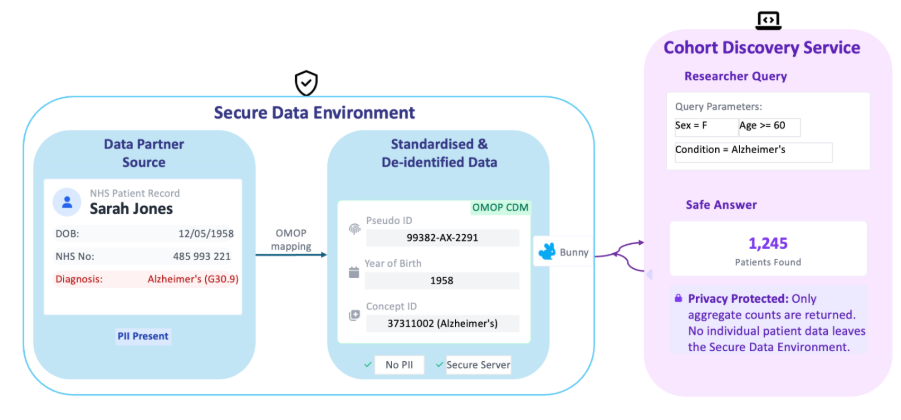
Secure Network Area
Each Data Custodian must provision a Secure Network Area — a network zone that:
- Is isolated from environments containing identifiable data
- Contains only the pseudonymised OMOP dataset and the query retrieval software
- Requires outbound HTTPS only (port 443) — no inbound firewall rules needed
- Supports OCI-compliant container runtimes (Docker, Podman, or Kubernetes)
Flexible deployment
The system can technically be configured so the query retrieval software does not sit in a separate VM, and the OMOP data can be a view on a larger datastore. However, clear separation between data zones is strongly recommended to simplify information governance reviews.
Infrastructure specification (Bunny)
| Requirement | Minimum Specification |
|---|---|
| CPU | 2 vCPUs |
| Memory (RAM) | 4 GB |
| Container Runtime | OCI-compliant (Docker, Podman, or Kubernetes) |
| Network | Outbound HTTPS (port 443) only |
| Database | PostgreSQL 14–18 · SQL Server 2019 or 2022 · DuckDB 1.x · Snowflake |
Requirements may vary
Requirements may vary depending on workload and deployment environment. See the Bunny user guide and deployment requirements for the latest specification.
What the Secure Network Area contains
The recommended minimal deployment contains exactly two components:
- The pseudonymised OMOP dataset — the minimum fields required for Cohort Discovery (see OMOP Requirements)
- The query retrieving software — e.g. Bunny, BC|INSIGHT, or a custom implementation
Query retrieval software options
Developed by the University of Nottingham. Bunny is the recommended open-source option.
- Fetches tasks from the Cohort Discovery API
- Makes only outgoing requests (outbound HTTPS)
- Supports obfuscation (low-count suppression and rounding)
- Can participate in federated networks via Hutch Relay
- Container images available for easy deployment
Developed by BC Platforms. A proprietary query retrieval tool.
Contact BC Platforms directly for installation instructions, contract options, and support.
Data Custodians are welcome to build their own query retrieval tool. It must meet the API standards documented in the Swagger documentation.
Contact the HDR UK Technology Team to discuss this option.